Logo RUB
  • Institute
    • ICAMS
      • Mission
      • Structure
      • Members
      • Fellows
      • Scientific Reports
    • Departments & Research Groups
      • Atomistic Modelling and Simulation
      • Scale-Bridging Thermodynamic and Kinetic Simulation
      • Micromechanical and Macroscopic Modelling

      • Artificial Intelligence for Integrated Material Science
      • Computational Design of Functional Interfaces
      • Scale-Bridging Simulation of Functional Composites
      • Materials Informatics and Data Science
      • High-Performance Computing in Materials Science
    • Central Services
      • Coordination Office
      • IT
  • Research
    • Overview
    • Publications
    • Software and Data
    • Collaborative research
    • Research networks
    • Young enterprises
  • Teaching
    • Overview
    • Materialwissenschaft B.Sc.
    • Materials Science and Simulation M.Sc.
    • ICAMS Graduate School
    • Student Projects
  • News & Events
    • Overview
    • News
    • Seminars and Workshops
    • Conferences
  • Services
    • Overview
    • Contact
    • Open positions
    • Travel information
 
ICAMS
ICAMS
MENÜ
  • RUB-STARTSEITE
  • Institute
    • ICAMS
    • Departments & Research Groups
    • Central Services
  • Research
    • Overview
    • Publications
    • Software and Data
    • Collaborative research
    • Research networks
    • Young enterprises
  • Teaching
    • Overview
    • Materialwissenschaft B.Sc.
    • Materials Science and Simulation M.Sc.
    • ICAMS Graduate School
    • Student Projects
  • News & Events
    • Overview
    • News
    • Seminars and Workshops
    • Conferences
  • Services
    • Overview
    • Contact
    • Open positions
    • Travel information
Home » Institute » Departments & Research Groups » Micromechanical and Macroscopic Modelling

Just another WordPress site - Ruhr-Universität Bochum

Department

Micromechanical and Macroscopic Modelling

Developing innovative materials that meet the complex requirements of a diverse range of applications is only possible if the relation between their inner structure, i.e. the microstructure, and their properties is thoroughly understood.


Alexander HartmaierRUB, Marquard
Prof. Dr. Alexander Hartmaier

Professor

Room: 02-517
Tel.: +49 234 32 29314
E-Mail: alexander.hartmaier@rub.de


Research

We derive such microstructure-property-relationships to predict macroscopic mechanical properties of materials like strength, hardness, and fracture toughness by employing the methods of computational materials science and multiscale modelling. To accomplish this, we typically start from macroscopic models that describe an engineering application or laboratory experiment and introduce information about mechanisms or material parameters derived from more fundamental scales; see Figure 1 for an example about scalebridging in fracture modelling.
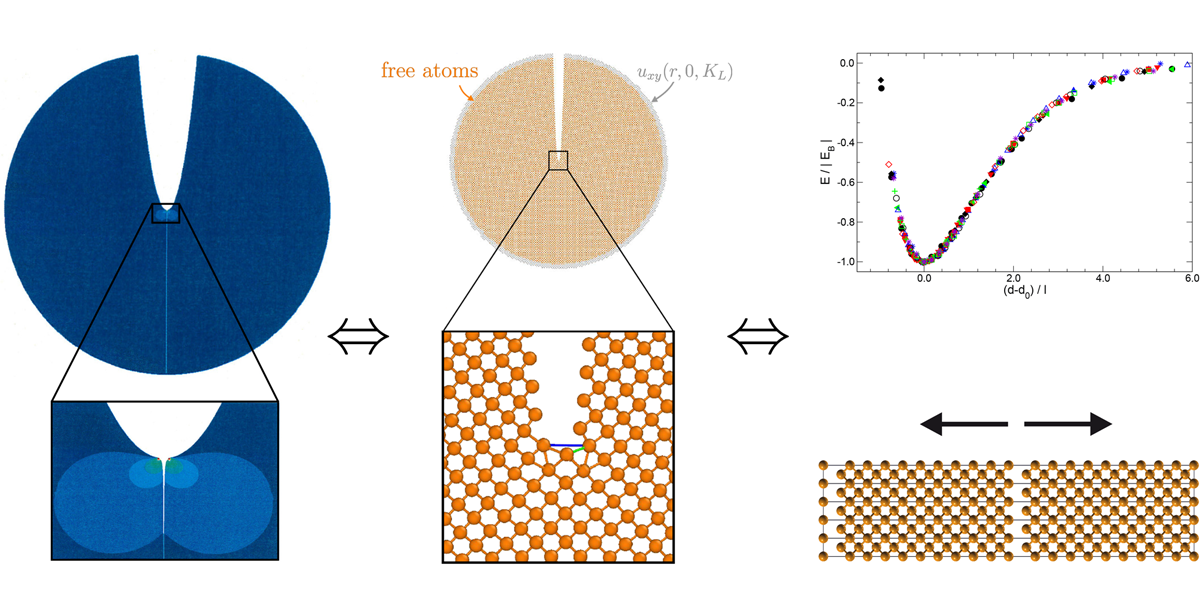
Bridging the scale: Atoms, microstructures, properties.
Fig. 1: A recently developed novel approach to bridge the scales from atoms to continuum in fracture modelling: With a physically consistent scaling law, data from density-functional calculations of atomic bond characteristics (right subfigure) can be directly applied in continuum fracture models (left subfigure). The approach has been validated with molecular dynamics simulations (middle subfigure)
ICAMS, RUB

Macromodels typically do not consider the microstructure of a material explicitly, but are based on the idea of homogeneous material behaviour, which is a severe restriction of such models. However, they can be very useful to identify critical regions with high mechanical stresses and strains within potentially damaging component or loading conditions. At such critical spots, a micromechanical model is employed that explicitly takes into account the local microstructure and mechanical conditions taken from the macro-simulation and is applied as boundary conditions to the microstructure model. The microstructure in such micromechanical models is described by representative volume elements (RVE) that can be developed on different purpose-specific levels of detail, to represent either phases as homogeneous regions or individual grains within phases or even sub-structures within grains. Such micromechanical models serve mainly two purposes: Firstly, they yield insight into the critical deformation and failure mechanisms and how they depend on the microstructure and local thermal, mechanical and chemical conditions of the material. Secondly, they provide the basis for macroscopic descriptions of material properties in the form of flow rules as they are used in continuum plasticity. This latter step of developing macroscopic flow rules based on micromechanical models is termed homogenisation and can be used to take microstructural properties and mechanisms implicitly into account in macroscopic models of engineering problems.

Members
  • Bhimavarapu, Hrushikesh Uday
  • Ghaderi, B.A. Farnoosh
  • Hartmaier, Prof. Dr. Alexander
  • Janisch, PD Dr. habil. Rebecca
  • Khazaei, Mobina
  • Lenz, Vladimir
  • Madadi, Mahkam
  • Masuch, Eva
  • Meydani, Erfan
  • Nguyen, Vu
  • Pan, M.Sc. Feng
  • Parhiyar, Muhammad
  • Rezek, Yousef
  • Sen, Onur
  • Shoghi, M.Sc. Ronak
  • Sidrah, Sidrah
  • Xue, Dr. Jun
Recent Publications
  • R. Shoghi, A. Hartmaier. A machine learning-based constitutive model incorporating history-dependent features for cyclic plasticity. Computer Methods in Applied Mechanics and Engineering, 448, 118524, (2026)
  • O. Sen, S. Benito, S. Weber et al. Increasing the content of CSL grain boundaries in ferritic steel through grain boundary engineering. Journal of Materials Research and Technology, 38, 4170-4177, (2025)
  • V. Nguyen. Finite element simulation of the evolution of surface roughness of a crystalline solid under cycllic load. Master Thesis, Ruhr-Universität Bochum, (2025)
  • C. Wang, M. Umair, Y. Jiang et al. Morphological evolution of γ' and γ'' precipitation in a model superalloy: Insights from 3D phase-field simulations. Computational Materials Science, 256, 113972, (2025)
  • J. Schmidt, S. Kalidindi, A. Hartmaier. A texture-dependent yield criterion based on support vector classification. International Journal of Plasticity, 188, 104311, (2025)
  • R. Shoghi, A. Hartmaier. A workflow-centric approach to generating FAIR data objects for computationally generated microstructure-sensitive mechanical data. Advanced Engineering Materials, 27, 2401876, (2025)

All publications

Theses
  • V. Nguyen. Finite element simulation of the evolution of surface roughness of a crystalline solid under cycllic load. Master Thesis, 2025
  • Al-Shboul, Oleksandr. Micromechanical modeling of damping in fiber-reinforced composite materials. Master Thesis, 2025
  • E. Meydani. Multiscale nanoindentation simulation of FCC and BCC single crystals: A camparative study using crystal plasticity and atomistic simulations. Master Thesis, 2025
  • R. Makhool. Micro-mechanical modelling of cemented carbide failure under thermal shock. Master Thesis, 2025
  • Taheri Mofassal, Azadeh. Microstructure generation, modeling and fatigue analysis of friction-stir welded joint of an additively manufactured component and a cast component. Master Thesis, 2024
  • Y. Rezek. Using machine learning surrogate models to determine material parameters by inverse analysis of indentation data. Master Thesis, 2024
  • T. Schmalofski. Sampling of the multidimensional parameter space of grain boundary energies with atomistic simulations and statistical methods. Ph.D., 2024
  • A. Jena. Calculating Indentation Schmid Factor (ISF) and Analyzing Complex Stress State During Nanoindentation Using Crystal Plastici. Master Thesis, 2024
  • H. Bhimavarapu. Modelling of adiabatic shear band initiation in polycrystals. Master Thesis, 2024
  • H. Sharma. Efficient fatigue modelling for large finite-element models. Master Thesis, 2024
  • A. Karusala. Molecular dynamics simulations of dislocation - grain boundary interaction during nanoindentation of tungsten bi-crystals. Master Thesis, 2024
  • N. Farzaliyeva. Machine-learning based surrogate models for cyclic indentation simulations. Master Thesis, 2024
  • N. Farzaliyeva. Machine learning surrogate models for finite element simulations of the indentation process. Master Thesis, 2024
  • Alvaro Garcia, Imam. A Comparison Analysis between Conventional and Machine Learning Model on Metal Plasticity. Master Thesis, 2023
  • B. Mushtaq. Determination of residual stresses in turbo gear units. Master Thesis, 2023
  • X. Song. Analysis and microstructure based simulation of fatigue damage in high-performance steels. Ph.D., 2023
  • Y. Jiang. Influence of free surface on cyclic plasticity and fatigue. Master Thesis, 2023
  • P. Nooshmehr. Training of machine learning models for the influence of porosity on the damage behavior of metals. Master Thesis, 2023
  • E. Mugabi. Investigation of the effects of grain orientation on the thermomechanical fatigue behavior of 316L stainlesssteel. Master Thesis, 2023
  • O. Sen. Atomistic simulations of crack-tip interface interactions in TiAl microstructures. Master Thesis, 2022
  • R. Öner. Evaluieren von Partikelsimulationen und Versuchen für die Auslegung und Optimierung eines kompakten Fliehkraftvorabschneiders. Master Thesis, 2022
  • N. Athanasopoulos. Atomistically-informed crystal plasticity simulations of hydrogen embrittlement in ferrite. Master Thesis, 2022
  • F. Valiente Dies. Development of a machine learning model to reconstruct 3D microstructures from 2D cuts. Master Thesis, 2022
  • Z. Hamzeh. Finite Element modelling of the influence of porosity in indentation tests. Master Thesis, 2022
  • A. Azócar Guzmán. Ab initio study of co-segregation effects of H and C at grain boundaries in ferritic steels. Ph.D., 2022
  • M.M. Matsuo. Hybrid FEM-ML in open die forging process. Master Thesis, 2022
  • Y. Chiang. Prediction of anisotropic behavior for porous 316L stainless steel by machine learning methods. Master Thesis, 2021
  • F. Frankus. Numerical investigation on the modalities of hydrogen-assisted crack growth in DCB specimen. Master Thesis, 2021
  • E. Fedorov. Accelerated force field development using active learning: the case of advanced electrolytes for Li-ion batteries. Master Thesis, 2021
  • I. Sravani Dandu. Identification of mechanical properties from incremental indentation test. Master Thesis, 2021
  • D. El Lahib. Verdichterschaufeln aus faserverstärktem Kunststoff für Turbomaschinen. Master Thesis, 2021
  • Oswal, Abhishek. Design and development of complex stressed polymer-metal hybrid structures. Master Thesis, 2021
  • Y. Lee. Prediciton of the load-path dependent bahavior of a polycrystalline material by micromechanical modeling. Master Thesis, 2021
  • Aliyev, Orkhan. Analyse des Dämpfungsverhaltens von faserverstärkten Polymermatrix-Verbundwerkstoffen mit Hilfe der Finite-Elemente-Methode. Bachelor Thesis, 2021
  • J. Schmidt. Prediction of Yld2004-18p anisotropic coefficients using ML methods. Master Thesis, 2021
  • A. Chauniyal. Deformation behavior of lamellar TiAl alloys – An atomistic study. Ph.D., 2021
  • A. Paiva do Nascimento. An optimized method to determine advanced yield surface initial parameters for sheet metal forming applications. Master Thesis, 2021
  • T. Muslubas. Optimierung der mechanischen Belastbarkeit von Überspannungsableitern im GFK-Kreuzwickeldesign. Bachelor Thesis, 2021
  • S. Sidrah. Scale-sensitive modeling of fracture and brittle-to-ductile transition in visco-plastic materials. Master Thesis, 2021
  • M. Ramaswamy Guru Prasad. Microstructure-sensitive modeling of mechanical behavior of polycrystalline metals and superalloys. Ph.D., 2021
  • J. Jeon. Crystal structure and mechanical properties of Cr-rich hard phases of type M7C3 in Fe-based alloys - simulation and experimental validation. Master Thesis, 2021
  • W. Amin. Micromechanical modeling of metals using strain gradient crystal plsticity-coupled phase field model. Ph.D., 2020
  • E. Norouzi. Analysis and application of machine learning approaches to identify parameters of a visco-plastic material model based on numerical and experimental data of copper. Master Thesis, 2020
  • S. Mirgilani. Evaluation of the influence of material thickness on the relevant parameters for the generation of FEM material cards. Master Thesis, 2020
  • A. Biswas. Micromechanical modeling of mechanical behavior of additively manufactured components. Ph.D., 2020
  • H. Sajjad. Constitutive modeling of cyclic plasticity and parameter assessment by inverse methods. Ph.D., 2020
  • B. Schaefer. Micromechanical modelling of fatigue crack initiation in the martensitic high-strength steel SAE 4150. Ph.D., 2020
  • Seif, Yehia F.A. Mohamed. Influence of finite-element parameters on indentation simulation and experimental validation. Master Thesis, 2020
  • Chuang, Kai-Chien. Machine learning model for predictin of nanoindentation. Master Thesis, 2020
  • N. Kusampudi. Using machine learning and data-driven approaches to predict damage initiation in dual-phase steel. Master Thesis, 2020
  • O. Mirzakhmedov. Inverse method for determining the flow curve of steels from indentation test. Master Thesis, 2020
  • Nerella, Dhanunjaya Kumar. Assessment of anisotropic yield behaviour of materials with crystallographic texture using machine learning. Master Thesis, 2019
  • K. Govind. Chemomechanical modeling of hydride transformation. Master Thesis, 2019
  • K. Govind. Chemomechanical modeling of hybride transformation in Ti. Master Thesis, 2019
  • S. Vincent. Investigation of α2 - ωo transformation pathway in Ti-Al-Nb alloys using ab-initio density functional theory. Master Thesis, 2019
  • Roongta, Sharan. Physics based crystal plasticity model for cyclic loading. Master Thesis, 2019
  • S. Rooein. Experimental analysis and micromechanical modeling of gas diffusion layers (GDL) for PEM fuel cell application. Master Thesis, 2019
  • H. Ganesan. Highly parallel molecular dynamics/Monte Carlo coupling towards solutes segregation modeling. Ph.D., 2019
  • E. Stewart. Scale effects on hardness obtained by molecular dynamics simulations of nanoindentation. Master Thesis, 2018
  • A. Saxena. Ab-initio DFT investigation of phase stability and transformation paths of Ti-Al-Nb. Master Thesis, 2018
  • Komissarenko, Vladimir. Evaluation and validation of the finite element simulation of the production procees of a contact lamella. Bachelor Thesis, 2017
  • S. Varada. Micromechanical modeling of fracture in martensitic steel. Master Thesis, 2017
  • W. Ye. Study of crack initiation in aluminium under cyclic loading by crystal plasticity and damage models. Master Thesis, 2017
  • X. Huang. Study of hydrogen segregation at iron grain boundaries via first-principle calculations. Master Thesis, 2017
  • S. Ahmed. Micromechanical modelling approach to derive the yield surface for bcc and fcc steels using representative volume elements and non-local crystal plasticity. Master Thesis, 2017
  • H. Heyn. Molecular dynamics simulation of nanoindentation of fcc & bcc: influence of hydrogen and vacancies. Master Thesis, 2016
  • S. Gao. 3D dicrete dislocation dynamics simulation of polycrystelline films and silicon electrostatics. Ph.D., 2016
  • Veluvali Pavan Laxmipathy. Influence of interstitial defects on the structural and mechanical properties of lamellar TiAl alloys. Master Thesis, 2016
  • A. Kauws. Investigation of mechanical properties of martensite packets using inverse analysis. Master Thesis, 2015
  • L. Sharma. Implementation and comparison of different damage criteria in the framework of crystal plasticity. Master Thesis, 2015
  • T. Katiyar. Phase-filed study of mechanically driven grain growth. Master Thesis, 2014
  • W. Arif. Superalloy single crystal creep deformation modelling by crystal plasticity finite element method. Master Thesis, 2014
  • Helle, Oliver. Selection and Develpment of a Low Cost Bond Coat System with Optimized Properties. Bachelor Thesis, 2013
  • V. Ganisetti. Multiscale modelling of the effect of oxygen on structure and cohesion of a symetric tilt grain boundary in molybdenum. Master Thesis, 2013
  • Fiolka, Maximilian. Studie zu Design und Konstruktion für ein integratives Kofferraumabschlussteil der Sportwagenbaureihen Boxter und Carrera in Faserverbundbauweise. Bachelor Thesis, 2013
  • B. Reinholz. Fatigue crack initiation at TiC precipitates in a NiTi matrix. Diploma, 2011


Groups

The groups of the department are:
Mechanical Properties of Interfaces

PD Dr. habil. Rebecca Janisch

Micromechanics of Large Deformations

N.N.


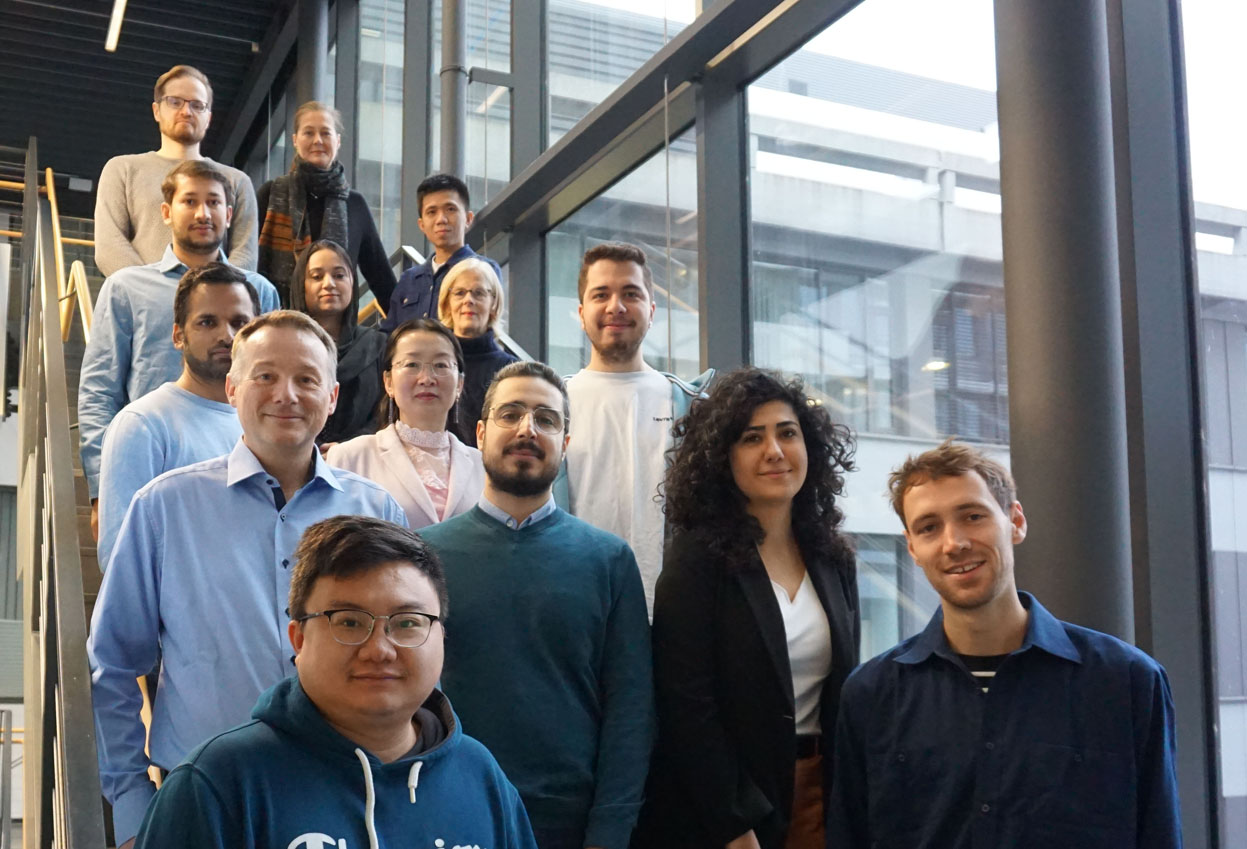
AMS group photo, November 2024.
MMM group photo, November 2024.
ICAMS, RUB
Contact and Office Hours

Department of Micromechanical and Macroscopic Modelling
ICAMS
Ruhr-Universität Bochum
Universitätsstr. 150
44801 Bochum
Germany

Building/Room: IC 02-515

E-Mail: mmm-office@rub.de

Tel.: +49 234 32 29368

Office hours:
Mon – Fri: 10.00 a.m. – 12.00
and 1.00 p.m. – 3.00 p.m.

Logo RUB
  • Open positions
  • Travel information
  • Imprint
  • Privacy Policy
  • Sitemap
Ruhr-Universität Bochum
Universitätsstraße 150
44801 Bochum

  • Open positions
  • Travel information
  • Imprint
  • Privacy Policy
  • Sitemap
Seitenanfang Kontrast N